The work in brief
Overview
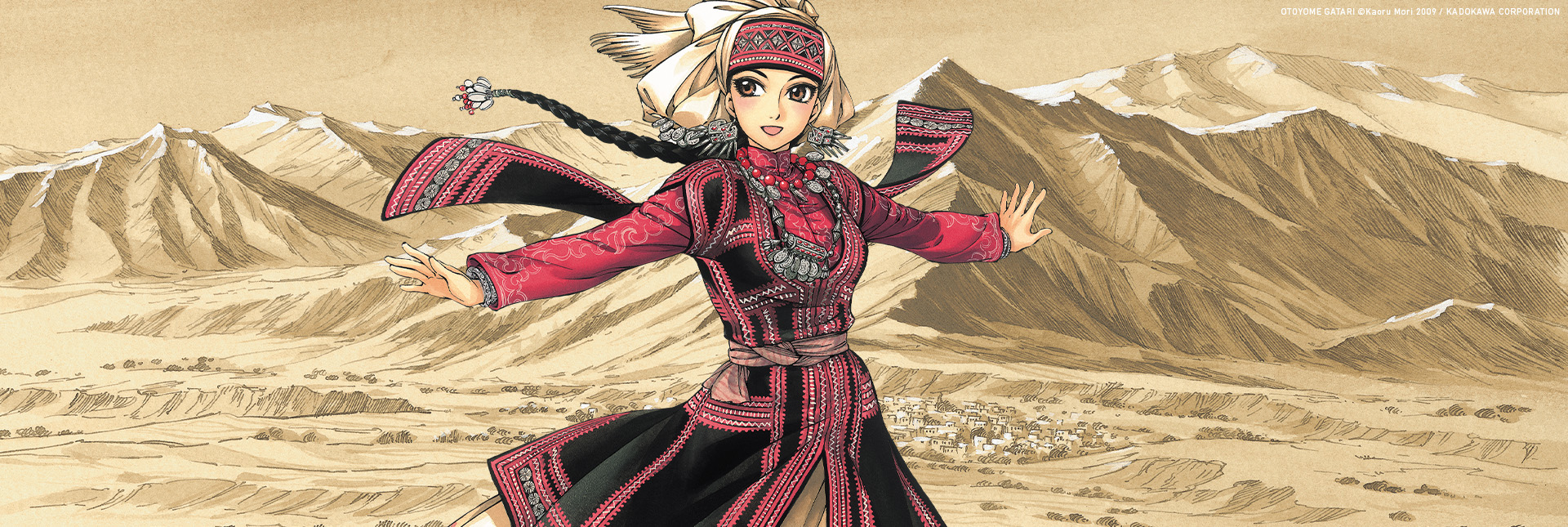
Amir, a 20-year-old woman from a nomadic tribe, marries Karluk, a 12-year-old boy from a settled farming family, in a Central Asian village near the Caspian Sea. The manga follows their quiet, patient relationship alongside the daily lives of other young women in the region, all set against the slow pressure of the Russian Empire’s expansion south.
On the road
Silk Road & regional elements
- Set directly on the historical Silk Road connecting Asia and Europe, during the real 19th-century “Great Game” period.
- Focuses on two contrasting lifestyles: the nomadic Halgal clan (hunting and herding) and the settled Eihon clan (farming).
- Kaoru Mori researched clothing, embroidery, wood carving, food (like pilaf), and even underwear in obsessive visual detail.
- Arranged marriage customs, tribal negotiation, and the tension between nomadic and settled ways of life run through the whole story.
Simple rating
Historical & cultural accuracy
Reader path
Why you might like it
- You want the most historically detailed slice-of-life Silk Road story available.
- You love quiet pacing, close relationships, and cultural detail over action.
- You’re curious about nomadic vs. settled life in 19th-century Central Asia.
- You appreciate master-level manga art and costume/craft accuracy.
Watch, read, buy & follow
Official links
All viewing and purchase links go to official publishers, stores, and streaming platforms. Reference databases are clearly labelled. No pirated copies, no shady sites — just direct paths to support the creators.
KADOKAWA Japanese edition for A Bride’s Story
Official Japanese publisher store page for 乙嫁語り, Volume 1, with series, ISBN, format, and purchase information.
KADOKAWA Japanese edition for A Bride’s Story Publisher · ENYen Press series page for A Bride’s Story
The official English publisher page with the complete volume list and publication details.
Yen Press series page for A Bride’s Story Buy · Yen PressA Bride’s Story, Volume 1
Official English digital and hardback editions, preview pages, ISBN details, and authorised retailers.
A Bride’s Story, Volume 1 Reference · ENWikipedia series overview for A Bride’s Story
Background on the manga, its 19th-century Central Asian setting, and publication history.
Wikipedia series overview for A Bride’s StoryLinks checked July 2026 · Reviewed every quarter for availability and publisher changes.
Companion collection
Central Asian Daily Life & Nomad Culture
This collection focuses on 19th-century Central Asian nomad and village life — embroidery, textiles, food, family structures, and caravan towns. It’s designed for people who love quiet slice-of-life stories set along the Silk Road and want visual and creative tools for that world.
View the full companion collectionDigital Download (PNG / SVG)
Central Asian Motifs: Embroidery & Textile Pattern Pack
A digital pack of motifs inspired by historical Central Asian embroidery and tribal textiles — borders, medallions, floral and geometric patterns.
- Seamless digital papers and fabric design.
- Embroidery, quilting, and craft projects.
- Backgrounds for journals, zines, and web pages.
TopicsCentral Asian embroidery patterns · Silk Road textile motifs · tribal digital pattern pack
Free PDF (Email Opt-In)
The Nomadic Hearth: 19th-Century Central Asian Life & Culture Guide
A short guide explaining daily life in 19th-century Central Asia:
- Nomad vs settled family structures.
- Food customs (bread, tea, pilaf).
- Clothing, embroidery, and household objects.
Ideal as a free resource for history fans, craft lovers, and educators. Available free when you join the mailing list.
TopicsCentral Asian nomad culture · Silk Road daily life · 19th century Central Asia guide
Digital Toolkit (PDF & Prompts)
Nomad & Village: Silk Road Daily Life Worldbuilding Toolkit
A toolkit for writers, TTRPG GMs, and AI artists who want grounded daily-life settings:
- Checklists for houses, village layouts, and nomad camps.
- Character archetypes (older bride, young husband, embroiderer, caravan guest).
- Scene prompts for quiet domestic moments and marketplace interactions.
TopicsSilk Road worldbuilding · Central Asia setting reference · TTRPG village and nomad toolkit
All products are independent historical and creative tools. They are not licensed or endorsed by any anime, manga, or game publisher; specific titles are mentioned only in editorial context.
Keep travelling